

Interpreting Complex Systems: The Glemad Model
Modern infrastructure produces signals that are dense, dynamic, and interdependent. Understanding these systems requires intelligence that can interpret complexity with coherence, stability, and context awareness.

Digital environments are not linear. They consist of interacting components, layered abstractions, stochastic behaviour, and constantly shifting conditions. Intelligence that operates in such environments must understand relationships rather than isolated events, and reason about context rather than surface signals.
Glemad’s research into interpreting complex systems focuses on enabling intelligence to form structured understanding from unstructured environments consistently, predictably, and with clarity.
Structured understanding over surface recognition
Many systems rely on pattern matching rather than true interpretation. This produces brittle behaviour when conditions shift. Our work aims to ensure intelligence constructs internal representations that reflect the underlying structure of systems, not just their appearance.
This includes understanding:
- causal relationships
- conditional dependencies
- system-wide interactions
- long-range effects of localized events
Such structure allows intelligence to remain stable even when signals are noisy or incomplete.
Coherence across multiple layers of information
Complex systems generate data across different layers logs, metrics, traces, behaviours, configurations, and more. Interpreting them requires intelligence that can integrate information across these layers into a coherent picture.
We evaluate coherence by measuring:
- consistent interpretation across different data types
- ability to reconcile conflicting information
- stability in the presence of partial signals
- the capacity to identify meaningful patterns without overfitting
This coherence is essential for dependable reasoning.
Contextual reasoning in dynamic environments
Complex systems change continuously. Intelligence must reason with an awareness of context, understanding not just what is happening, but why and how it relates to broader system behaviour.
This includes:
- identifying when a signal is normal variation or a meaningful shift
- reasoning about temporality and sequence
- understanding intent behind system behaviour
- mapping local observations to global state
Context transforms raw data into structured insight.
Robustness under uncertainty
Ambiguity is inherent in complex systems. Signals may be missing, contradictory, or misleading. Dependable intelligence must maintain clarity without collapsing into false confidence or erratic behaviour.
Our research examines:
- uncertainty quantification
- reasoning stability under ambiguity
- resilience to adversarial noise
- calibrated decision-making
Robust interpretation ensures the system remains grounded regardless of pressure.
The role of constraints
Interpretation benefits from boundaries. Constraints prevent overgeneralization and guide intelligence toward interpretations consistent with the known behaviour of the system.
We use constraints to:
- shape reasoning pathways
- maintain coherence under scale
- avoid speculative inference
- reinforce alignment with intended behaviour
Constraints strengthen reliability without diminishing capability.
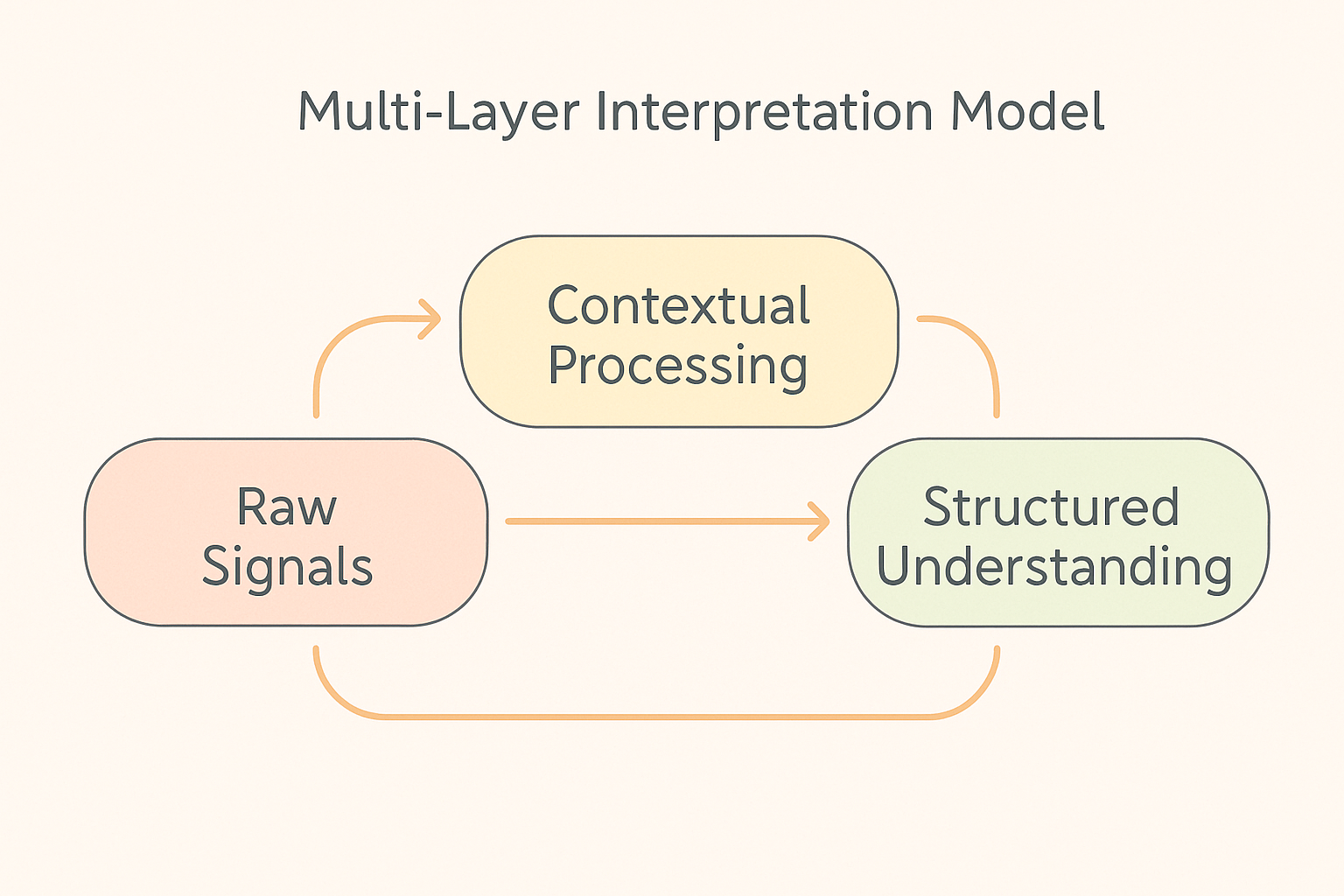
“Complex systems demand intelligence that can reason with context, structure, and discipline. Interpretation is not classification it is understanding. And understanding is the basis of every dependable system.”
; David Idris, Founder & CEO
Interpreting complex systems is a core requirement for intelligence intended to support critical environments. Glemad’s work focuses on building systems that do more than recognize patterns systems that understand structure, reason with clarity, remain stable under uncertainty, and preserve alignment even as complexity increases.
This research underpins much of the capability that will later define our intelligence models.