

Foundations of Defensive Reasoning
Defensive reasoning is the core discipline behind ADT.

Why defensive reasoning is different from general reasoning
Most AI systems are designed to produce the most helpful answer across a wide range of tasks. They optimize for fluency, creativity, and adaptiveness. Defensive reasoning begins from a different premise: the goal is not flexibility, but correctness; not expressiveness, but clarity; not breadth, but discipline.
In critical systems, intelligence must operate under constraints defined by law, policy, safety, and reliability. It must reason within boundaries, disclose uncertainty, and maintain coherence even when information is incomplete or compromised.
Defensive reasoning exists to meet these requirements.
The structure of defensive reasoning
Defensive reasoning is built on the idea that intelligence should reflect the structure of the environment it operates in. This includes:
- formal rules and regulatory frameworks
- organizational policies and risk thresholds
- historical behavioral patterns
- contextual dependencies across systems
- environmental uncertainty and adversarial pressure
Instead of improvising, the model organizes these signals into a structured interpretation of the system.
The role of evidence in defensive reasoning
Evidence as the anchor of interpretation
Every conclusion in a defensive system must map directly to observable evidence. The model must avoid speculation and instead:
- identify what is known
- distinguish what is unclear
- evaluate how much weight each signal carries
- form interpretations only within defensible limits
Evidence is not supplemental, it is the foundation of reasoning integrity.
Handling ambiguity without collapse
Critical systems often present conflicting, noisy, or partial signals. Defensive reasoning manages this by:
- maintaining parallel hypotheses
- narrowing conclusions to what can be justified
- refusing to fill gaps with unsupported inference
- elevating uncertainty when evidence is insufficient
Uncertainty becomes a parameter, not a failure.
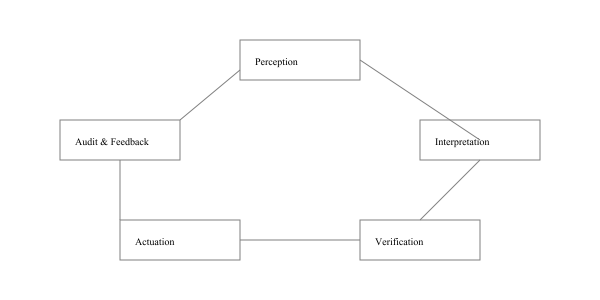
Boundaries as cognitive structure
Defensive reasoning operates within explicit boundaries derived from policy and institutional rules. These boundaries serve as:
- constraints on model behaviour
- interpretive structure for decision-making
- safeguards against harmful or high-risk conclusions
- tools for maintaining stability under pressure
Boundaries give defensive reasoning shape allowing it to behave predictably even as environments shift.
Why defensive reasoning is essential for institutional AI
Institutions do not operate in speculative spaces.
They operate in regulated, resource-sensitive, consequence-driven environments.
Defensive reasoning ensures that:
- intelligence remains aligned with institutional obligations
- decisions are traceable, reviewable, and accountable
- behaviour does not drift under adversarial pressure
- interpretations remain anchored in policy and evidence
This discipline enables AI to strengthen the systems that sustain modern society rather than destabilize them.