

Fault or attack, the question every operator needs answered first
Every serious outage and every serious intrusion begins with the same uncertain minute. The institutions that answer it early, with evidence, keep their services running.
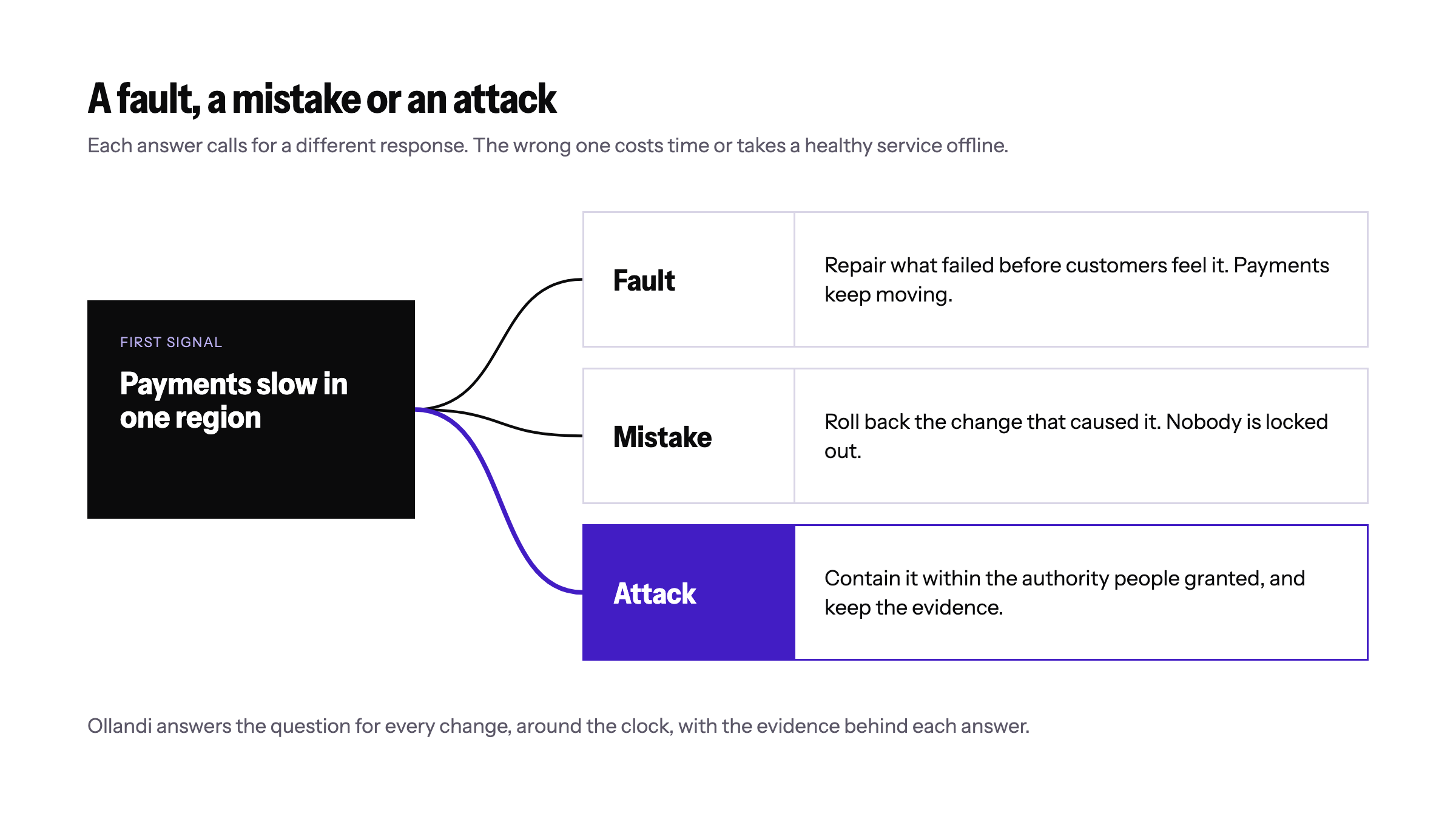
Every failure in critical infrastructure begins the same way. A payment queue slows. Sign-ins start failing in one region. A configuration changes on a core router at an hour nobody planned for. In that first minute no one knows whether they are looking at a fault, a mistake or the opening move of an attack.
That question decides everything that follows. Treat an attack as a fault and the attacker gets time, the most valuable thing a defender can give away. Treat a fault as an attack and a healthy service is taken offline, customers are locked out and the institution does the attacker's work for them.
The first minutes cost the most
Most operations teams answer the question late, because their tools were built to answer it late. Monitoring sees the fault. Security tools see the threat. Each watches its own slice and raises its own alarm, and people reconcile them by hand once the damage is visible. By then every choice left is a bad one.
A bank whose payments slow during a credential attack, a mobile operator whose fibre degrades during a routing change, a hospital whose clinical system stalls after a software update. Each needs the same answer, and each needs it while there is still time to act.
Small is when it matters
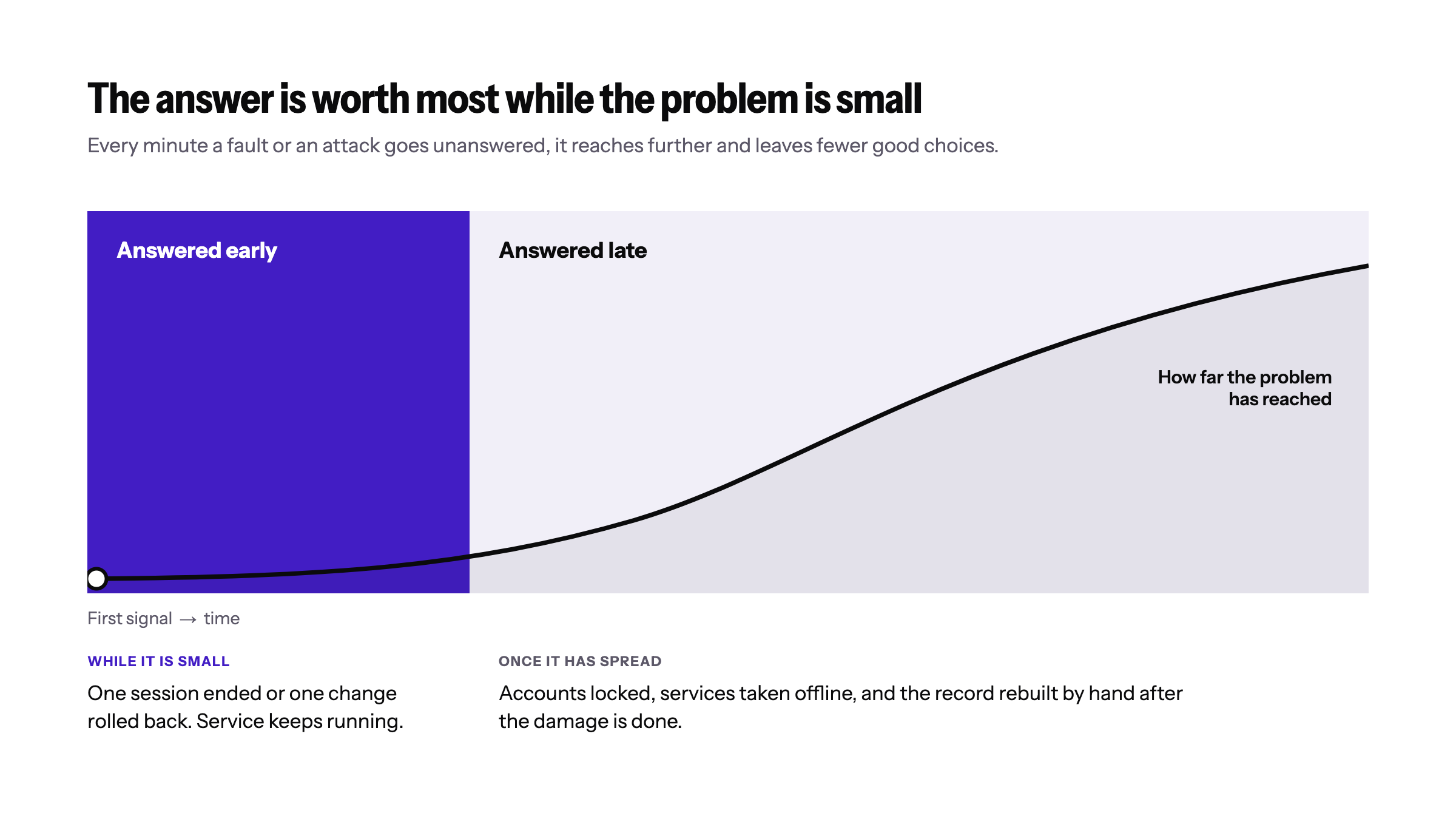
An attacker holding one account can be stopped by ending one session. An attacker who has moved through the network cannot be stopped that easily. A misconfigured router is a quiet correction before traffic shifts around it and an outage after. The answer is worth most while the problem is still small, and it loses value with every minute it spreads.
That is why Ollandi asks the question of every change, around the clock, across every system an institution runs. It does not wait for something to break before it starts thinking.
An answer is only as good as its evidence
A verdict that cannot explain itself cannot be trusted with authority. Glemad holds every Ollandi judgement to one standard. It shows what it saw, what else it weighed and why it settled where it did. When the evidence is incomplete, it says so, and a person decides.
That standard is what lets an institution grant authority with confidence. Ollandi acts only as far as people allow, under Observe & Notify, Assisted Response or Controlled Autonomy. Every action is recorded, and any action can be undone as quickly as it was taken.
What every operator should be able to answer
- When something changes, how soon do we know whether it is a fault, a mistake or an attack?
- Does that answer come with the evidence behind it?
- Who decided how far our defense may act, and can every action be reversed?
- Does the record of what happened stay with us, where our board and our regulator can see it?
The questions Glemad Research is pursuing
Faults and attacks are not always separate. Attackers hide inside ordinary failures, and some cause failures on purpose. A defender has to recognise both at once.
A defender also has to know how sure it is. An honest "not yet certain", handed to the right person at the right moment, is worth more than a confident wrong answer.
And infrastructure never stops changing. A judgement that was right last month can be wrong today, so the defender has to keep learning without ever gaining authority nobody gave it.
Glemad Research tests this work against adversarial scenarios and real operational faults across live environments, and holds every result to the standard set out in its Model Evaluation and Red-Teaming framework.
The institutions that keep their services running will be the ones that know, early and with evidence, what they are looking at. Ollandi gives them that answer while the problem is still small.


