

ADT-4 Pro: A Reinforced Architecture for Signal Interpretation, Drift Detection, and System-Level Reasoning
Unified Reasoning Core

ADT-4 Pro is an expanded iteration of the Autonomous Defense Transformer framework. This release introduces stronger capabilities for interpreting operational signals, detecting behavioral deviations, and reasoning about dependencies within complex environments. The model builds on the foundations of ADT-4 and extends its ability to support analysis of real-world systems that operate under changing conditions, incomplete information, and distributed structure.
ADT-4 Pro is intended for research on stable, accountable intelligence for security-critical environments.
Research Objectives
The development of ADT-4 Pro focuses on three goals:
- Improving the model’s ability to interpret logs, policies, identities, and configuration data in a consistent manner.
- Strengthening detection of distributional shifts, outliers, and long-term drift across dynamic systems.
- Expanding structural reasoning across identity graphs, service dependencies, network relationships, and workload interactions.
These objectives support investigations into how artificial intelligence can maintain clarity and stability when reasoning about large, heterogeneous environments.
Model Enhancements
Signal Interpretation
ADT-4 Pro introduces a refined capability for processing operational text and structured telemetry.
Research findings show improvements in:
- identifying key events within high-volume logs
- relating system states to configuration changes
- interpreting policy text in relation to observed behavior
- consolidating distributed signals into coherent summaries
This supports further study of how models can align their interpretation with real-world operational constraints.
Deviation and Drift Detection
The model includes enhanced mechanisms for identifying changes in behavior across time and systems.
Areas of improvement include:
- sensitivity to subtle distribution shifts
- early identification of emerging anomalies
- detection of dormant or irregular patterns in identity and system activity
- long-term drift recognition across hybrid environments
Research focuses on how these mechanisms contribute to early-stage detection without relying on rule heuristics.
Structural and Dependency Reasoning
ADT-4 Pro expands its ability to reason about relationships between entities.
Improvements include:
- more accurate mapping of identity chains and permission structures
- clearer representation of cross-service dependencies
- detection of irregular interaction patterns in network or process graphs
- improved reasoning about how local events may influence broader systems
This supports ongoing work on multi-step reasoning across distributed and interconnected environments.
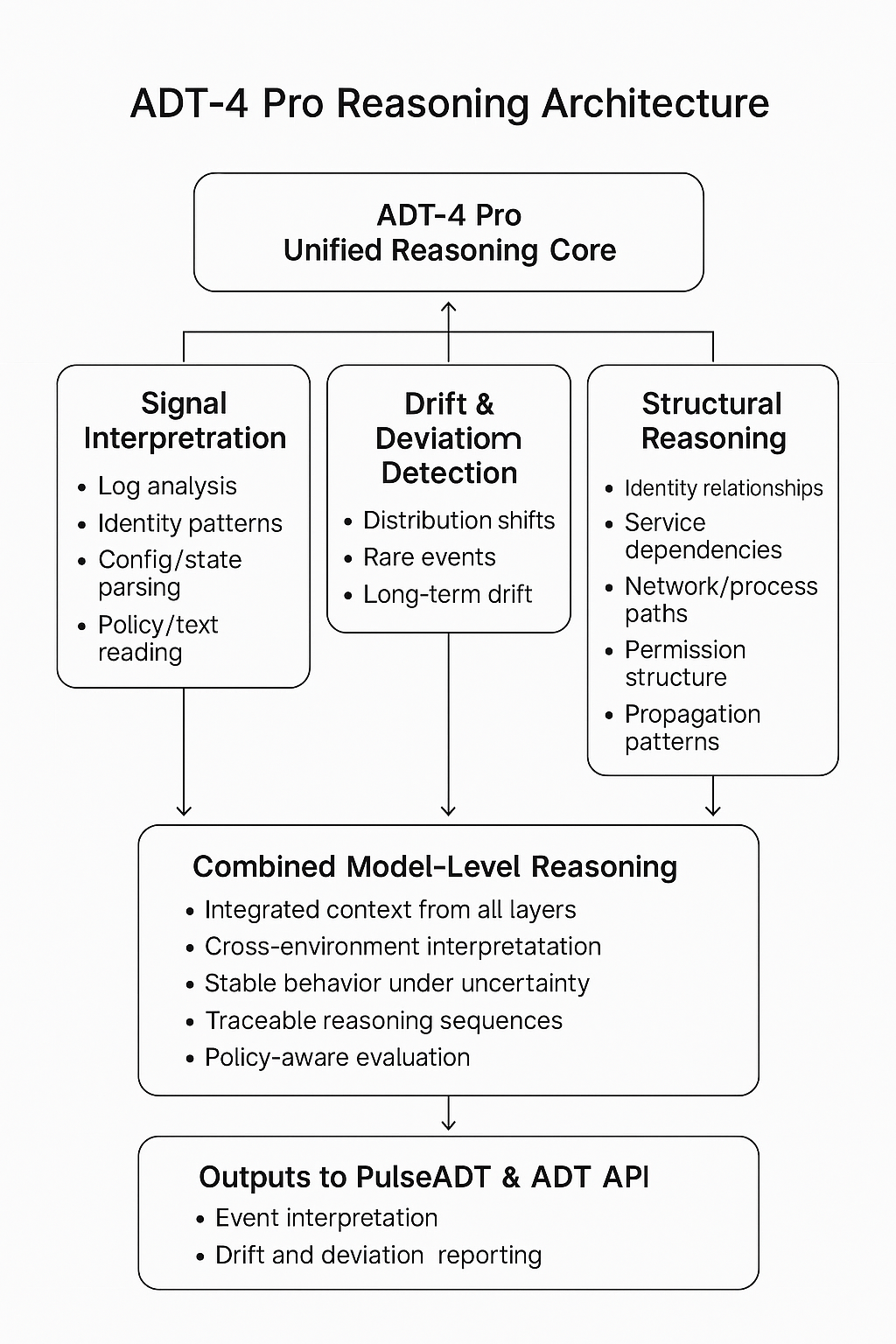
Behavioral Characteristics
Stability under uncertainty
The model maintains consistent interpretation when telemetry is incomplete or conflicting, and clearly indicates uncertainty when required.
Traceability
Outputs are structured to support inspection of reasoning steps, contributing to research on transparent and reviewable model behavior.
Policy-aware alignment
The model incorporates constraints derived from institutional, operational, and procedural requirements rather than user intuition alone.
Evaluation Summary
ADT-4 Pro was evaluated on tasks representing:
- multi-source log interpretation
- deviation recognition and drift modeling
- structural dependency analysis
- long-form investigative reasoning
- policy-grounded evaluation sequences
Across these areas, the model demonstrates improved clarity, stronger internal consistency, and more reliable interpretation of operational data.
Full evaluation details will be provided in the corresponding technical report.
Research Applications
ADT-4 Pro is being used in ongoing studies related to:
- autonomous reasoning in complex operational settings
- stable decision-support under uncertainty
- graph-based system modeling
- long-horizon interpretation of distributed telemetry
- model transparency and auditability
These research directions examine how artificial intelligence can support institutional environments that require dependable interpretation rather than open-ended generation.
Availability
ADT-4 Pro is available for research access through the ADT API and is integrated into internal evaluation pipelines at Glemad Research. External collaborators participating in research programs may request access for institutional studies and experimentation.
Future Work
Subsequent versions will continue to explore:
- multi-agent defensive reasoning
- formal verification of reasoning chains
- hybrid symbolic–neural reasoning approaches
- improved handling of incomplete or noisy telemetry
- broader alignment with operational and regulatory constraints