

Alignment & Responsibility Framework
This framework outlines how Glemad defines alignment, evaluates it, and embeds responsibility into the design and deployment of intelligent systems.

Intelligent systems will increasingly shape decisions, mediate information flows, and interact with environments where precision and safety are essential. For intelligence to be suitable for institutional use, it must demonstrate alignment across its reasoning, boundaries, incentives, and long-term behaviour.
The responsibility to ensure this alignment rests with the institutions that design these systems. At Glemad, alignment is not an auxiliary concern it is a foundational engineering requirement and a core research discipline.
This framework defines the principles we use to guide alignment and the responsibility we accept in deploying advanced intelligence.
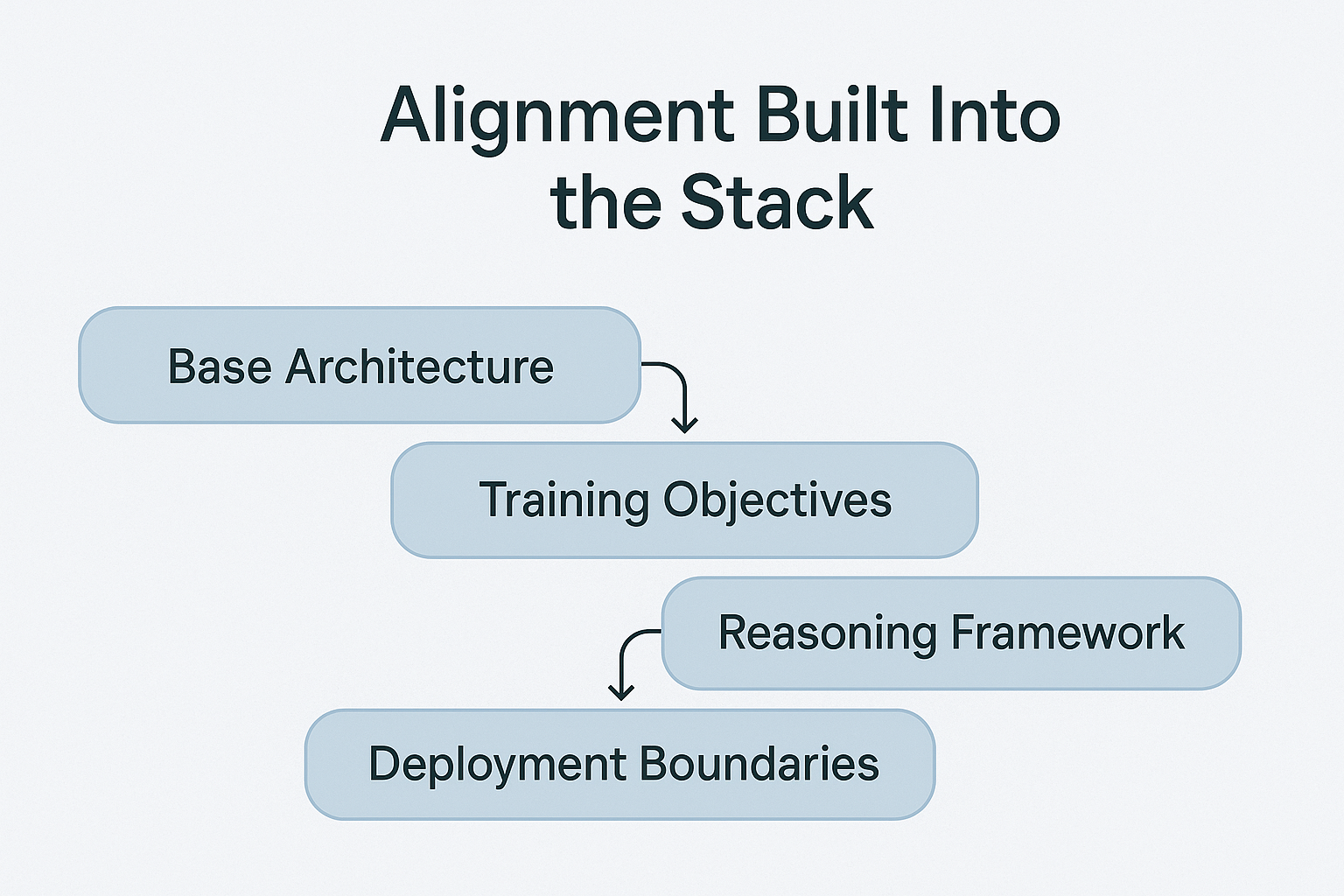
Alignment as Architecture, Not Afterthought
Alignment cannot be enforced through patches or external rules alone. It must be built into how the system interprets information, constructs reasoning, and evaluates actions.
This includes:
- architectural constraints
- training objectives that penalize drift
- structured representations that promote grounded reasoning
- behavioural frameworks that ensure consistency
Behavioural Predictability
Aligned systems behave in ways that are consistent with human intent, even as the environment changes. Predictability is more important than breadth of capability.
Behavioural alignment requires:
- stable reasoning patterns
- avoidance of uncontrolled generalization
- consistent adherence to defined boundaries
- clear interpretability of outputs
Boundary Definition and Enforcement
Intelligence must operate within limits. Boundaries define what actions, interpretations, or decisions a system is allowed to make. These constraints protect against misuse, misgeneralization, and unintended inference.
We define boundaries across three layers:
- Epistemic boundaries; what the system is allowed to infer
- Operational boundaries; what actions it may take
- Context boundaries; where it may be applied
Each layer includes explicit checks and evaluation criteria.
Long-Horizon Alignment
Systems that appear aligned at small scale may diverge as capability grows. We evaluate alignment not only in present behaviour, but in how behaviour evolves under higher complexity.
This requires:
- trajectory monitoring
- drift detection
- long-range simulations
- failure mode anticipation
Responsibility in Deployment
Dependable intelligence requires structured responsibility. Deployment must follow strict criteria, ensuring that systems are only released when:
- behaviour is thoroughly understood
- boundaries are enforced reliably
- monitoring systems are in place
- accountability mechanisms are defined
We treat deployment as a governance decision, not a technical milestone.
Evaluation Standards
Alignment evaluation requires methods that go beyond performance benchmarks. We rely on frameworks that measure:
- reasoning integrity
- boundary adherence
- stable decision-making under uncertainty
- resistance to adversarial perturbation
- alignment preservation under scale
Evaluation is continuous before, during, and after deployment.
This framework establishes the criteria under which Glemad designs, evaluates, and deploys intelligent systems. Alignment and responsibility are not parallel tracks; they are the structure that informs every research decision we make.
As our work progresses and our systems evolve, these principles will continue to serve as our foundation.