

Alignment Considerations for ADT
ADT’s alignment strategy is designed to preserve stability, intent, and predictable behaviour as capability increases.

Alignment is central to ADT’s design. As intelligence becomes more capable, the risks of misgeneralization, unstable reasoning, or boundary drift increase. To build a system that can support institutional environments, alignment must be treated as a structural property, something embedded throughout the system rather than introduced after capability emerges.
This document explains how ADT maintains alignment across its architecture, reasoning processes, and behavioural evaluations.
Alignment as a Structural Constraint
For ADT, alignment is not a secondary system layered onto an existing architecture. It informs:
- how the system interprets information
- which reasoning paths it may take
- how its internal representations form
- how it generalizes under new conditions
- how boundaries are preserved under scaling
The architecture is intentionally shaped so that aligned behaviour is the default behaviour.
Stability of Intent
Intelligent systems must remain aligned with intended objectives even as they process new information or face unfamiliar scenarios. ADT uses mechanisms that maintain intent stability:
- intent encoding: embedding explicit operational intent in the system’s core
- boundary-aware reasoning: reasoning processes structured to avoid unbounded inference
- drift prevention: internal checks that identify deviation from expected behaviours
Stability of intent ensures that increased capability does not erode alignment.
Reasoning Integrity
Aligned systems require coherent, transparent reasoning. ADT’s reasoning framework emphasizes:
- consistent multi-step reasoning chains
- interpretability of internal transitions
- grounded inferences tied to system constraints
- avoidance of speculative or unsupported reasoning paths
Integrity of reasoning produces reliability of behaviour.
Boundary Preservation
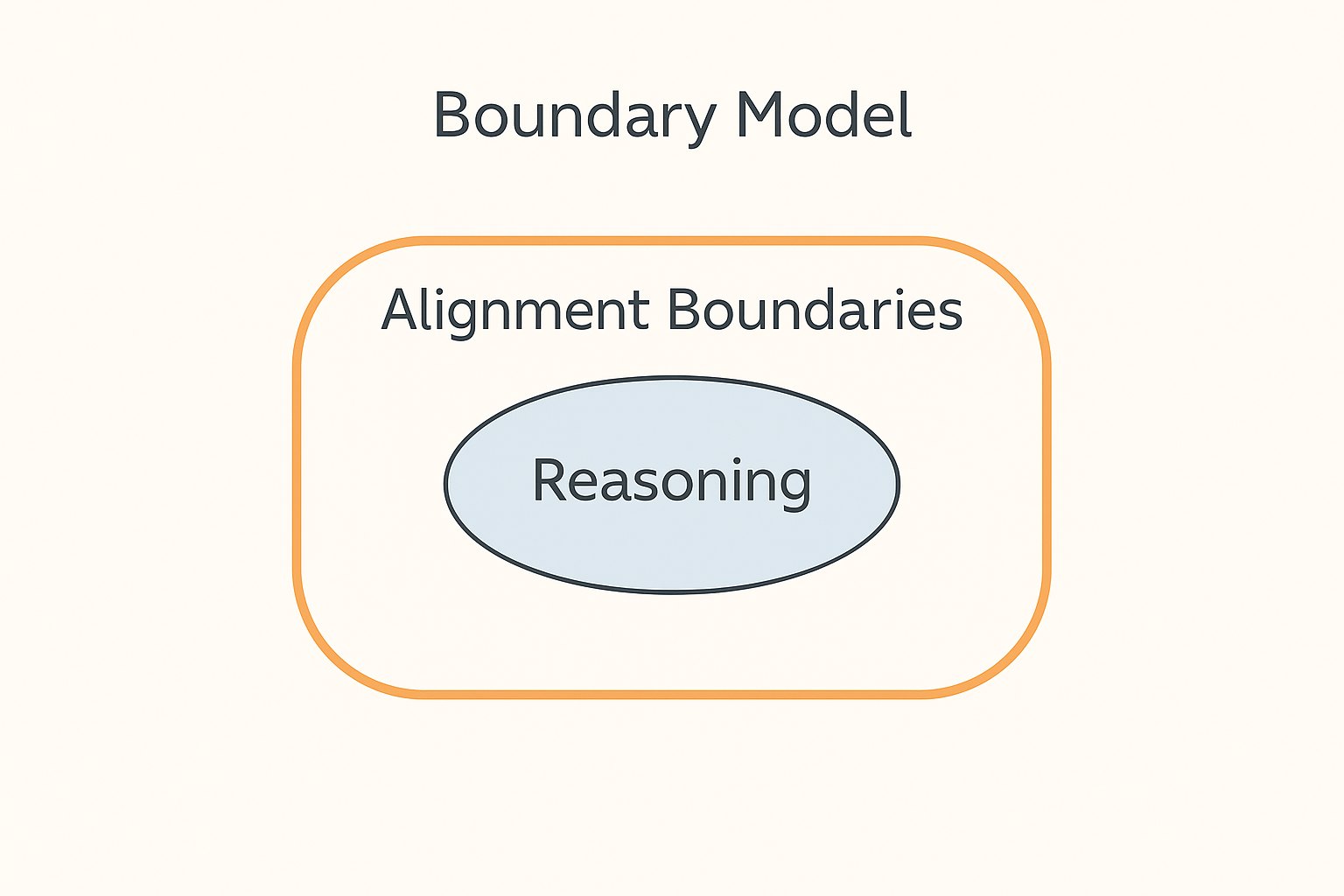
A core alignment goal is ensuring ADT stays within clearly defined boundaries across:
- epistemic limits (what it may infer)
- operational limits (how far reasoning may extend)
- contextual limits (domains where application is appropriate)
Boundaries prevent capability from expanding into areas where the system should not operate.
Alignment Under Scale
Capabilities increase with scale, and so must alignment. ADT’s scaling philosophy ensures:
- alignment constraints strengthen as the model grows
- evaluation becomes more rigorous at each capability milestone
- drift detection becomes more sensitive
- interpretability methods evolve with model depth
Scaling is treated as something that requires renewed responsibility, not passive expansion.
Evaluation Framework
Evaluating alignment requires methods that extend beyond accuracy benchmarks. ADT’s evaluation includes:
6.1 Behavioural Evaluation
Testing consistency, predictability, and response stability.
6.2 Boundary Adherence
Verifying that the system does not cross epistemic or contextual limits.
6.3 Stress Conditions
Observing behaviour under:
- ambiguous signals
- conflicting instructions
- partial context
- perturbations or noise
6.4 Alignment Degradation Tests
Probing for gradual drift as tasks become more complex.
6.5 Long-Horizon Reasoning Tests
Ensuring conclusions remain grounded over extended sequences.
6.6 Adversarial Robustness
Testing against prompts or conditions designed to induce unsafe behaviour.
This evaluation cycle runs continuously as ADT evolves.
Responsibility in Development
ADT is built under the assumption that:
- no intelligent system should be deployed without understanding its limitations
- alignment must be monitored continuously
- evaluation must be transparent and repeatable
- safety considerations define the boundary of every deployment decision
Responsibility is not symbolic; it is operational.
ADT’s alignment framework reflects Glemad’s commitment to building intelligence that is stable, interpretable, and trustworthy. As the system grows in capability, alignment is reinforced; not diluted. This ensures ADT remains suitable for environments where reliability is essential and errors carry real consequences.
Future publications will detail ADT’s evaluation methods at each release milestone.